How To Boost Brain Memory? 10 Science-Backed Ways
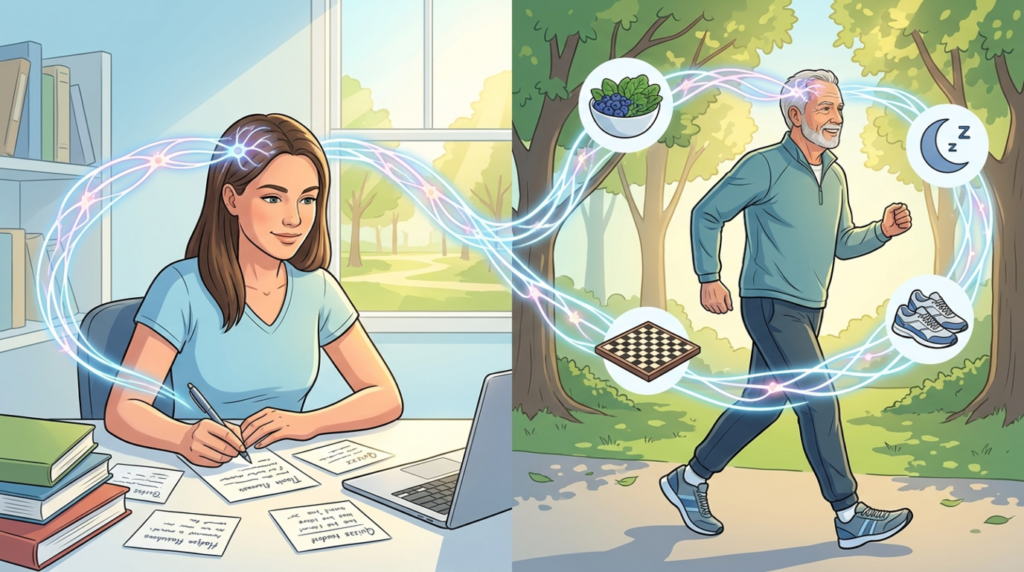
You can boost your brain memory by combining a few proven habits: regular aerobic exercise, smart study techniques like self-testing, a brain-friendly diet, good sleep, and mental challenges.
The research behind these is real. In a year-long trial, older adults who walked 40 minutes three times a week grew their hippocampus, the brain’s memory center, by about 2%, effectively reversing one to two years of age-related shrinkage.
Students who practiced recalling information remembered 61% of a passage a week later, compared with 40% for those who simply reread it.
And on a bigger scale, the 2024 Lancet Commission estimated that about 45% of dementia cases could be prevented or delayed by addressing 14 modifiable risk factors.
Whether you’re a student cramming for exams or an older adult wanting to stay sharp, this guide covers how to improve your memory naturally, the best brain foods, memory exercises that actually work, and ways to prevent memory loss in old age.
Can You Really Boost Your Brain Memory?
Yes. Your brain changes throughout life based on how you use it, how you move, what you eat, and how well you sleep. Scientists call this ability to adapt neuroplasticity.
Memory improvement looks different depending on your goal:
| Your Goal | What Helps Most |
|---|---|
| Learning and remembering new information (students) | Self-testing, spaced study, sleep |
| Staying sharp in middle age | Exercise, diet, managing blood pressure and cholesterol |
| Preventing memory loss in old age | Exercise, hearing care, social connection, brain training |
| Improving everyday short-term memory | Focus, chunking, routines, reducing distractions |
| Addressing new memory problems | Medical checkup for reversible causes |
The good news? Many of the most effective strategies are free.
What Are 10 Ways To Improve Memory?
Here are 10 ways to improve memory, each backed by research or expert guidance.
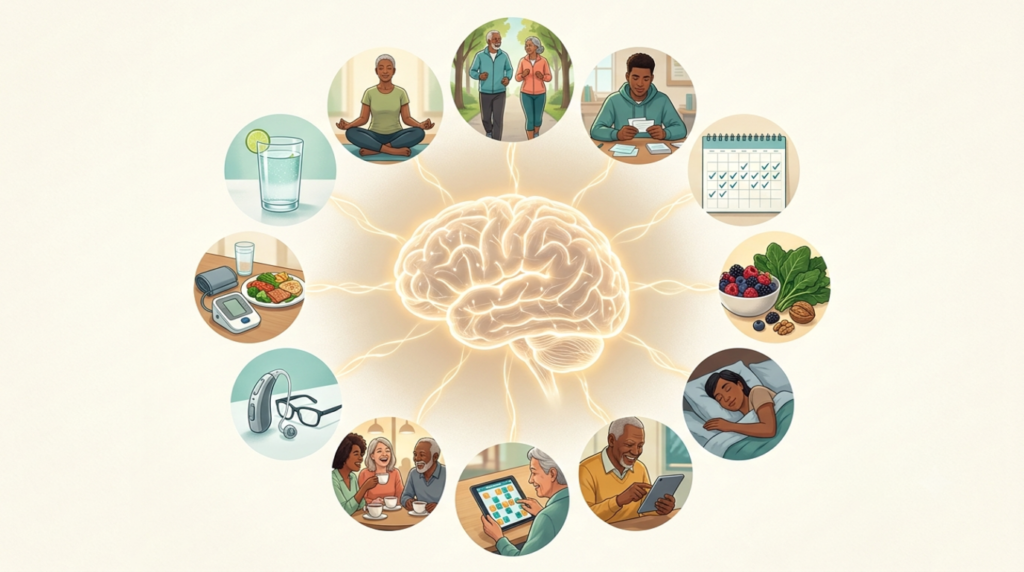
1. Get Moving With Aerobic Exercise: Exercise is one of the most powerful ways to improve brain health. In a randomized trial published in the Proceedings of the National Academy of Sciences, 120 older adults were assigned to either aerobic walking or stretching. After a year, the walkers’ hippocampus grew by about 2%, while the stretching group lost about 1.4%, a decline considered normal with age.
The walkers also improved more on a spatial memory test. The program was simple: previously sedentary adults aged 55 to 80 walked around a track for 40 minutes, three days a week.
How to start: brisk walking, cycling, swimming, or dancing. Build up gradually to about 40 minutes, three or more times a week.
2. Test Yourself Instead Of Rereading: Rereading notes feels productive, but it’s one of the weakest ways to remember. Self-testing, called retrieval practice, is far stronger.
In Roediger and Karpicke’s 2006 experiments, students who practiced recalling a passage retained 61% a week later, compared with 40% for those who reread it. Interestingly, the rereaders did better on a test just minutes later, but the results flipped after a week.
How to do it: close your book and write down everything you remember, use flashcards, or answer practice questions.
3. Space Out Your Learning: Instead of cramming, review information over several days. Researchers note that spacing, like retrieval practice, enhances long-term learning even though it may feel harder in the short term.
Example schedule: review new material the same day, then after 1 day, 3 days, 1 week, and 2 weeks.
4. Eat A Brain-Friendly Diet: The MIND diet, which blends the Mediterranean and DASH diets, emphasizes leafy greens, berries, nuts, beans, whole grains, fish, and olive oil. Observational research linked close adherence to as much as a 53% lower risk of Alzheimer’s disease. More on brain foods below.
5. Prioritize Sleep: Your brain uses sleep to consolidate memories, turning short-term information into longer-lasting memories. Mayo Clinic lists stress, anxiety, and depression among reversible causes of forgetfulness, and poor sleep often makes all of these worse.
Aim for: a consistent bedtime and wake time, and about 7 to 9 hours for most adults.
6. Challenge Your Brain With The Right Training: Not all brain games are equal. In the NIH-funded ACTIVE trial, older adults who completed speed-of-processing training with booster sessions had a 25% lower risk of dementia over 20 years. Memory and reasoning training didn’t significantly reduce dementia risk.
7. Stay Socially Connected: Social isolation is one of the 14 modifiable dementia risk factors identified by the Lancet Commission. Conversations, group activities, and volunteering all keep your brain engaged.
8. Protect Your Hearing And Vision: Hearing loss is among the most significant modifiable risk factors for dementia, and untreated vision loss was added to the list in 2024. Get regular hearing and eye checks, and use hearing aids or glasses if you need them.
9. Manage Blood Pressure, Cholesterol, And Blood Sugar: High blood pressure, diabetes, and high LDL cholesterol are all midlife risk factors for dementia. What’s good for your heart is good for your brain.
10. Reduce Stress And Limit Alcohol: Chronic stress can cause forgetfulness and difficulty concentrating, according to Mayo Clinic. Excessive alcohol is also a dementia risk factor. Try relaxation techniques, regular breaks, and cutting back on drinking.
How To Improve Short Term Memory?
Short-term memory, sometimes called working memory, holds small bits of information for a brief time.
You use it to remember a phone number, follow directions, or keep track of a conversation.
These practical techniques can help:
| Technique | How It Works | Example |
|---|---|---|
| Chunking | Group information into smaller sets | Remember 9845321076 as 984-532-1076 |
| Repetition | Say information aloud a few times | Repeat a new name right after hearing it |
| Visualization | Create a mental picture | Picture a “Rose” holding roses |
| Focus on one task | Avoid multitasking | Silence notifications while reading |
| Write it down | Offload memory to paper | Keep a small notebook or phone list |
| Use routines | Keep items in fixed places | Keys always go in the same bowl |
| Teach it | Explain information to someone else | Summarize an article for a friend |
Quick tip: when you meet someone new, use their name in conversation right away. “Nice to meet you, Priya. Priya, how do you know Sam?” This simple repetition helps lock it in.
How To Increase Memory Power In Students Naturally
Students don’t need special pills to build a sharp memory. Learning science points to a handful of proven, free techniques.
Use Active Recall
Instead of highlighting or rereading, quiz yourself. The 2006 Roediger and Karpicke research showed self-testing beat rereading by a wide margin one week later. Researchers also found retrieval practice beat concept mapping for learning science material.
Space Your Study Sessions
Cramming may help for a test tomorrow, but spaced study helps you actually remember. Spread your study across days and weeks.
Mix Up Topics
Switching between different types of problems, called interleaving, works similarly to spacing and retrieval practice, helping long-term learning even though it feels harder at first.
Sleep Before And After Studying
Pulling all-nighters works against you. Sleep helps your brain store what you learned during the day.
Exercise Regularly
Physical activity supports the hippocampus, the brain area most involved in forming memories.
Limit Distractions
Phones and notifications split your attention. Try studying in focused blocks, such as 25 to 50 minutes, followed by short breaks.
| Study Habit | Weak Version | Strong Version |
|---|---|---|
| Reviewing | Rereading notes | Self-testing with flashcards |
| Timing | Cramming the night before | Spacing over several days |
| Practice | Same type of problem repeatedly | Mixing different problem types |
| Sleep | All-nighters | Consistent 7 to 9 hours |
| Focus | Studying with phone nearby | Phone in another room |
What Are The Best Foods For Brain Health?
The best foods for brain health are part of an overall eating pattern rather than a single “superfood.”
The MIND diet is the most studied pattern for brain health.
What Does The MIND Diet Include?
| Brain Boosting Foods To Eat Often | Foods To Limit |
|---|---|
| Leafy green vegetables | Red meat |
| Other vegetables | Butter and stick margarine |
| Berries | Cheese |
| Nuts | Pastries and sweets |
| Beans | Fried or fast food |
| Whole grains | |
| Fish | |
| Poultry | |
| Olive oil |
Berries are the only fruit specifically included in the MIND diet.
What Does The Research Say About The MIND Diet?
The evidence is promising but more complicated than headlines suggest.
The encouraging findings: a 2015 study of 923 older adults from Rush University found that those who followed the MIND diet most closely had up to a 53% lower risk of Alzheimer’s, and moderate followers had about a 35% lower risk. Researchers also noted that the longer people followed the diet, the lower their risk seemed to be.
The honest counterpoint: that study was observational, so it couldn’t prove cause and effect. In 2023, a randomized trial published in the New England Journal of Medicine followed 604 older adults with a family history of Alzheimer’s for three years. Both the MIND diet group and the control diet group improved their cognition, with no significant difference between them. Both groups lost about 5 kilograms, which researchers suggested might explain the improvement.
What this means for you: a MIND-style diet supports heart health and overall wellbeing, and heart health is closely tied to brain health. Just think of it as part of a healthy lifestyle rather than a guaranteed memory booster.
What Is The Best Brain Food For Memory?
There’s no single magic food, but these are excellent choices:
- Fatty fish (salmon, sardines, mackerel): NCCIH notes that eating fish shows the most consistent positive findings among dietary factors studied for preventing cognitive decline.
- Leafy greens (spinach, kale, methi, collard greens)
- Berries (blueberries, strawberries)
- Nuts (walnuts, almonds)
- Beans and lentils
- Whole grains (oats, brown rice, whole wheat)
- Olive oil
What Memory Exercises Actually Work?
Brain exercises for memory come in many forms. Some have strong research behind them, while others are more about enjoyment.
Speed-Of-Processing Training
This has the strongest long-term evidence. In the ACTIVE trial, speed training involved computer tasks that required finding visual information quickly, getting harder as participants improved.
Over 20 years, 40% of the speed-trained group with boosters were diagnosed with dementia, compared with 49% of the control group.
Memory Training Exercises
These classic memory improvement exercises can help with everyday recall:
| Exercise | How To Do It |
|---|---|
| Memory palace (method of loci) | Picture items placed in rooms of a familiar house, then “walk through” to recall them |
| Story method | Link items in a list into a silly story |
| Acronyms | Create a word from first letters (like ROYGBIV for rainbow colors) |
| Recall practice | After reading, close the book and summarize from memory |
| Spaced flashcards | Review cards at increasing time gaps |
| Name-face association | Link a person’s name with a visual feature |
Cognitive Training Exercises For Daily Life
These activities keep your brain challenged:
- Learning a new language
- Playing a musical instrument
- Taking up a new hobby like painting or chess
- Taking a class
- Doing strategy games and puzzles that get progressively harder
Key principle: the best cognitive training exercises are adaptive and challenging. If an activity feels easy, it’s probably not stretching your brain much.
How To Keep Your Brain Healthy As You Age?
The strongest evidence for long-term brain health comes from combining several habits at once.
The U.S. POINTER trial, published in JAMA in July 2025, tested this approach in 2,111 older adults at risk of cognitive decline.
Participants worked on physical activity, nutrition, cognitive and social challenges, and health monitoring.
Both groups improved their cognition, but the structured group, which received more support and accountability, improved more.
The benefits appeared regardless of sex, ethnicity, genetic risk, or heart health.
Lesson: you’ll likely get better results with structure and support, such as a walking group, a class, or a friend to keep you accountable.
What Are 10 Ways To Prevent Alzheimer’s?
No method guarantees you’ll avoid Alzheimer’s disease, but you can lower your risk.
These 10 ways to prevent Alzheimer’s are based on the 2024 Lancet Commission’s modifiable risk factors:
- Treat hearing loss with hearing aids if needed.
- Lower high LDL cholesterol with diet, exercise, or medication.
- Control blood pressure.
- Stay physically active.
- Manage diabetes and blood sugar.
- Don’t smoke.
- Limit alcohol.
- Treat depression.
- Stay socially connected.
- Protect your head from injury, and get vision problems treated.
The Lancet Commission also lists less education, obesity, air pollution, and untreated vision loss among the 14 risk factors.
Hearing loss and high LDL cholesterol each account for about 7% of potentially preventable cases, the largest shares.
How To Reverse Cognitive Decline?
Whether cognitive decline can be reversed depends on the cause. Our full article on restoring lost brain function covers what can and can’t come back.
Often reversible: Mayo Clinic lists several possible causes of reversible memory loss, including medication side effects, stress, anxiety, depression, vitamin B12 deficiency, and an underactive thyroid.
Sometimes reversible: mild cognitive impairment (MCI). In a Mayo Clinic study, 38% of people with MCI reverted to normal cognition, though many later developed problems again.
Not currently reversible: progressive dementias like Alzheimer’s disease.
Steps to take:
- See a doctor to check for reversible causes.
- Review all medications with your doctor or pharmacist.
- Treat any vitamin deficiencies, thyroid problems, or mood conditions.
- Start a combined lifestyle approach with exercise, diet, brain training, and social connection.
What Is Good For Memory Loss?
If you’re already noticing memory loss, start with a medical evaluation. Then consider these evidence-based steps:
| Approach | Why It Helps |
|---|---|
| Medical checkup | Finds reversible causes |
| Regular aerobic exercise | Shown to grow the hippocampus in older adults |
| Speed-of-processing training | Linked to lower dementia risk over 20 years |
| Hearing and vision care | Addresses major modifiable risk factors |
| Daily multivitamin (older adults) | Slowed cognitive aging by about two years in the COSMOS trials |
| Vitamin B12 (if deficient) | Deficiency is common in older adults and affects memory |
| Memory aids | Calendars, pill organizers, and lists reduce daily stress |
| Social activities | Keeps the brain engaged |
Most other memory supplements have weak evidence. If you’re wondering which is the best supplement for brain memory, our evidence-based ranking breaks it down.
NCCIH says there’s currently no strong evidence that any complementary health approach can prevent cognitive impairment.
What Does A Brain-Boosting Day Look Like?
Here’s a sample routine combining the strategies above:
| Time | Activity |
|---|---|
| Morning | Brisk 40-minute walk |
| Breakfast | Oats with berries and walnuts |
| Work or study | Focused blocks with phone away; self-test on new material |
| Lunch | Leafy green salad with beans, olive oil, and whole grains |
| Afternoon | Short break and a call with a friend |
| Evening | 15 to 20 minutes of brain training or learning a new skill |
| Dinner | Grilled fish with vegetables |
| Night | Screens off an hour before bed; consistent bedtime |
What Memory Mistakes Should You Avoid?
These common habits work against a sharp memory:
- Rereading instead of self-testing
- Cramming instead of spacing
- Multitasking during important tasks
- Skipping sleep to study or work
- Sitting all day without movement
- Ignoring hearing loss
- Relying on memory pills with weak evidence
- Dismissing new memory problems as “just age”
If you’re considering a popular formula, read our honest look at CogniSurge’s claims before you buy.
When Should You See A Doctor About Memory?
See a doctor if you notice:
- Memory problems that are getting worse
- Trouble managing money, bills, or medications
- Getting lost in familiar places
- Repeating questions often
- Changes in mood, personality, or judgment
Seek urgent care if memory loss or confusion comes on suddenly, especially with headache, weakness, trouble speaking, or a recent head injury.
What Is The Bottom Line On Boosting Your Brain Memory?
Boosting your brain memory doesn’t require expensive pills or complicated programs.
The most reliable tools are surprisingly simple: brisk walking to support your hippocampus, self-testing and spaced study to lock in new information, a MIND-style diet rich in vegetables, berries, nuts, and fish, quality sleep, and challenging mental activities like speed-based brain training.
For long-term brain health, look at the bigger picture. Treat hearing and vision loss, manage blood pressure and cholesterol, stay socially connected, and check with a doctor about any new memory problems, since some causes are fully reversible.
Start with one or two changes, build them into your routine, and add more over time. Your brain responds to small, consistent efforts at any age.
What Do People Ask Most About Boosting Brain Memory?
How Can I Improve My Memory Quickly?
Improving your memory quickly starts with better focus, self-testing, and good sleep. Quizzing yourself instead of rereading helped students remember 61% of material a week later versus 40% for rereading. Longer-term gains come from exercise and healthy habits.
What Are 10 Ways To Improve Memory?
Improving memory works best with these 10 habits: aerobic exercise, self-testing, spaced learning, a MIND-style diet, good sleep, speed-based brain training, social connection, hearing and vision care, managing blood pressure and cholesterol, and reducing stress and alcohol.
How Can Students Increase Memory Power Naturally?
Students can increase memory power naturally with active recall, spaced study sessions, mixing topics, regular sleep, and exercise. Self-testing is one of the most reliable learning techniques in cognitive psychology. Avoid cramming and all-nighters.
What Are The Best Foods For Brain Health?
The best foods for brain health include leafy greens, berries, nuts, beans, whole grains, fish, and olive oil. These are the core of the MIND diet. Limiting red meat, fried food, sweets, butter, and cheese is also recommended.
What Memory Exercises Really Work?
Memory exercises with the strongest evidence are adaptive speed-of-processing training and self-testing. Speed training lowered dementia risk by 25% over 20 years in the ACTIVE trial. Techniques like the memory palace help with everyday recall.
How Can I Prevent Memory Loss In Old Age?
Preventing memory loss in old age involves staying active, treating hearing and vision loss, managing blood pressure and cholesterol, and staying socially connected. The 2024 Lancet Commission estimated about 45% of dementia cases could be prevented or delayed.
Can You Reverse Cognitive Decline?
Reversing cognitive decline is often possible when the cause is treatable, such as vitamin B12 deficiency, thyroid problems, medication side effects, or depression. About 38% of people with mild cognitive impairment reverted to normal in one study. Alzheimer’s can’t currently be reversed.
Does Exercise Really Improve Memory?
Exercise really does improve memory, according to a randomized trial in older adults. Walking 40 minutes three times a week for a year increased hippocampus size by about 2% and improved spatial memory more than stretching did.
Does The MIND Diet Improve Memory?
The MIND diet was linked to up to a 53% lower Alzheimer’s risk in an observational study. However, a 2023 randomized trial found no significant cognitive difference compared with a healthy control diet over three years. It remains a smart choice for overall health.
References
- Erickson KI, Voss MW, Prakash RS, et al. “Exercise Training Increases Size of Hippocampus and Improves Memory.” Proceedings of the National Academy of Sciences. 2011;108(7):3017-3022. A randomized trial of 120 older adults found that one year of aerobic exercise increased hippocampal volume by about 2% and improved spatial memory.
- Baker LD, Espeland MA, Whitmer RA, et al. “Structured vs Self-Guided Multidomain Lifestyle Interventions for Global Cognitive Function: The US POINTER Randomized Clinical Trial.” JAMA. 2025. The trial included 2,111 older adults and found greater cognitive improvement with a structured lifestyle program involving exercise, diet, cognitive activity, social engagement, and cardiovascular health monitoring.
- National Institutes of Health. “Cognitive Speed Training Over Weeks May Delay the Diagnosis of Dementia Over Decades.” 2026. NIH summarizes the 20-year ACTIVE follow-up, which found a 25% lower rate of dementia diagnosis among participants who completed speed-of-processing training with booster sessions.
- Mayo Clinic Health System. “When to Seek Help for Memory Loss.” This guidance discusses potentially reversible causes of memory problems, including medications, stress, anxiety, depression, sleep disorders, alcohol use, and vitamin B12 deficiency.
- National Center for Complementary and Integrative Health (NCCIH). “Dietary Supplements and Cognitive Function, Dementia, and Alzheimer’s Disease.” NCCIH reviews evidence for supplements and complementary approaches and notes that strong evidence for preventing cognitive impairment is lacking.